First World War
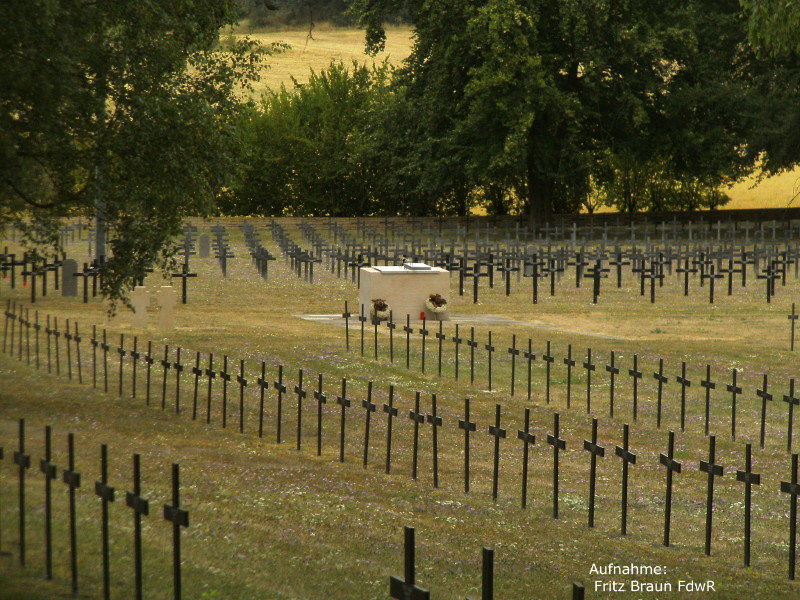
The German military cemetery Berru, Département Marne, was established in April 1923 by the French military authorities as a collective cemetery. The dead resting here today were transferred from an area stretching from Fismes (30 kilometers west of Reims) to the Argonne (80 kilometers east of Reims) and from Châtillon on the Marne (25 kilometers southwest of Reims to Berry-au-Bac (20 kilometers northwest of Reims) and encompassing the area of more than 150 municipalities and districts. As late as 1929, several hundred fallen soldiers or those who had died in French military hospitals were temporarily buried far south of the Marne and the Seine. Only a small number fell in the summer of 1914. The number of fallen increased considerably with the German retreat from the Marne and the major French attack in the winter of 1914/1915, the autumn battle in Champagne in 1915, the French offensive in Champagne and at Chemin-des-Dames in the spring of 1917. The German offensive operations in July 1918 and the retreat battles in October of the same year claimed further dead buried there.
The fallen belonged to units whose home garrisons were located in all countries and provinces of the then German Reich.
Repair work between the wars
Initial work to improve the condition of the cemetery was carried out by the Volksbund Deutsche Kriegsgräberfürsorge e.V. (German War Graves Commission) on the basis of an agreement reached with the responsible French military authorities in 1926. However, the problem of permanently marking the graves remained unresolved due to a lack of foreign currency and the Second World War.
Final design
After the conclusion of the Franco-German War Graves Agreement of July 19, 1966, the Volksbund Deutsche Kriegsgräberfürsorge e.V. (German War Graves Commission) - with financial support from the German government - was able to begin the final design of the German military cemeteries of the First World War in France.
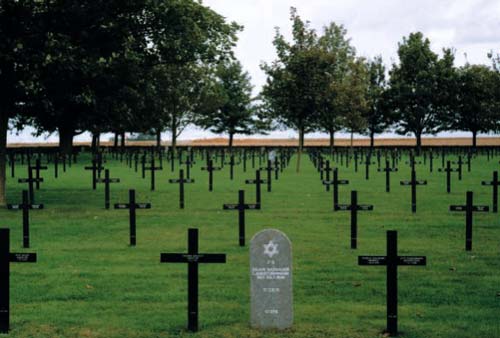
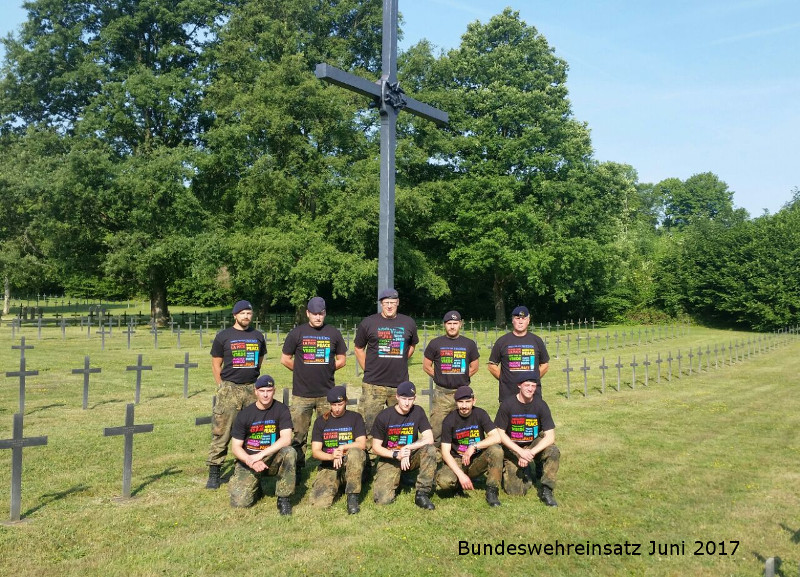
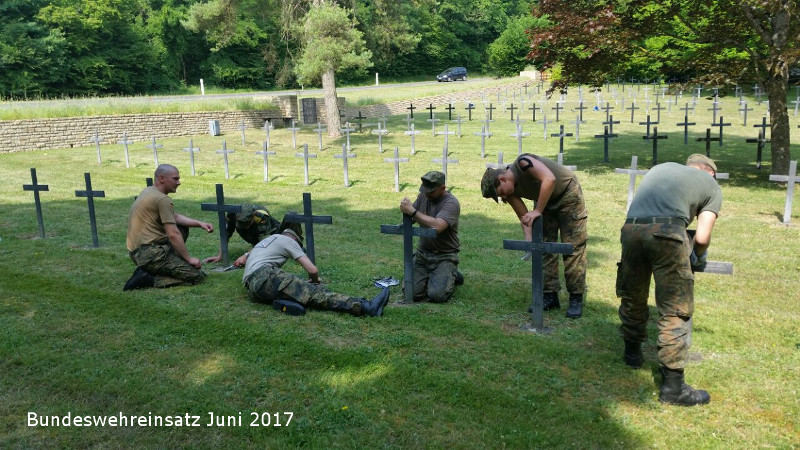
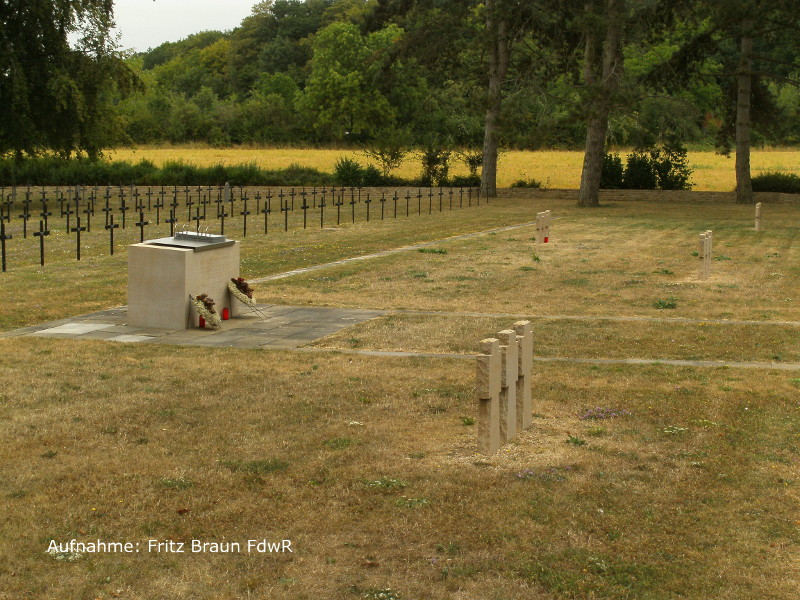
In addition to a fundamental landscaping overhaul, in which volunteers from the Volksbund's youth camps actively participated, the previous temporary wooden grave markers were replaced in 1970 with metal crosses with the names and dates of those buried here cast into them. Young people were also involved. They moved the cross foundations for the new crosses, which weighed 35 kilograms and were transported by the German army. In this way, young people and soldiers supported the Volksbund in fulfilling its tasks in a particularly impressive way. In addition, a new entrance with a forged gate and natural stone wing walls, which continue into an earth wall with a natural stone covering and shrubbery, was created. A high cross made of forged steel now towers over the cemetery.
Of the 17,567 fallen, 4,509 rest in individual and group graves; 379 remain unnamed. In the two common graves with 13,058 victims, 1,466 are known by name.
For religious reasons, the 15 graves of Jewish victims were marked with a natural stone stele instead of a cross. The Hebrew characters read:
1. (above) Here rests buried ...
2. (below) May his soul be interwoven into the circle of the living.
Maintenance
The cemetery is constantly cared for by the Volksbund's maintenance service.
Information
Information about the location of graves, the former affiliation of the fallen to certain units etc. can be obtained from the
Volksbund Deutsche Kriegsgräberfürsorge e.V.
Federal Office
War Graves Service Department and
International Relations
Sonnenallee 1
D-34266 Niestetal
Telephone: 0561-7009-0
gn@volksbund.de www.volksbund.de