Germany
Berlin-Wedding, Urnenfriedhof Seestraße
Total Occupation: 650 fatalities
Total Occupation: 650 fatalities
Address
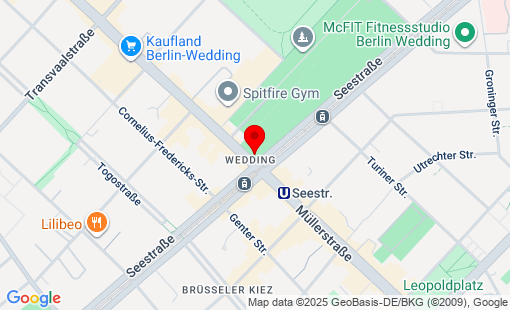
Seestr, 92-93
13347 Wedding, Seestraße, Urnenfriedhof
Germany
Today's Seestraße Urn Cemetery was opened as a burial ground for the Charité's deceased. The municipality of Berlin took over the cemetery on April 1, 1906 and has used it exclusively for urn burials since 1922, with extensions in 1924 and 1937. Right next to the side entrance, several bronze plaques and a boulder with the inscription "Here rest 295 victims of the National Socialist dictatorship" indicate collective graves. Most of the urns on the lawn contain ashes of victims of the mass murder of the disabled, the so-called "euthanasia" and concentration camp victims. Most of the victims died in 1940 and 1941 in the Hartheim, Bernburg, Grafeneck, Sonnenstein, Hadamar-Mönchberg, Dachau and Buchenwald "asylums" and concentration camps. However, the victims murdered in the Plötzensee and Brandenburg penitentiaries are also buried in these collective graves. These include the urns of 18 opponents of the regime, 16 of whom were Czechs, who were executed in Plötzensee on July 12/13, 1943, and the urns of 39 unknown women allegedly found dead in the Bessemer Straße women's prison on August 24, 1943. From the same entrance, you can see the memorial to the victims of June 17, 1953, which depicts a male figure tied to a block and struggling painfully to free himself. Six victims rest in front of the memorial. In addition, memorial slabs were laid out for 2 victims whose actual grave location is still unknown. Not far from the collective graves is a small burial ground with around 20 and a larger one with around 200 graves of the victims of war and tyranny. This also includes the grave of one of the first victims to die at the Wall: Ida Siekmann lost her life on August 22, 1961 by jumping through a window into freedom.