Germany
Berlin-Charlottenburg, Berlin 1939-1945 War Cemetery (CWGC)
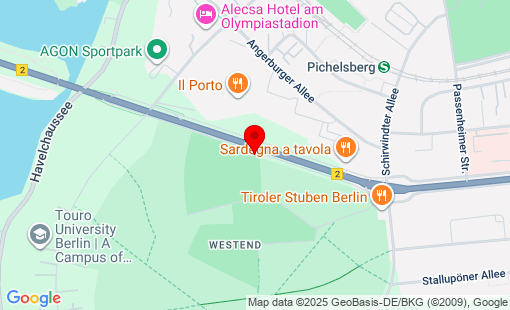
Address
Heerstr. 149-159
14055 Charlottenburg, Heerstraße, brit. Fdh.
Germany
After the First World War, an agreement between the German government and the United Kingdom regulated the care of British military graves and cemeteries located on German territory. This was confirmed by another bilateral agreement on March 5, 1956. The overall design of this cemetery follows a tradition that was established in 1918 after the end of the First World War. At that time, the British Parliament enacted a law that made a design proposal by Lieutenant Colonel and Director of the British Museum Sir Frederic Kenyon, GBE, the basis for all subsequent military cemeteries in the Commonwealth. This regulation provides for a short lawn, grave steles made of British Portland sandstone, as well as the high cross with bronze sword and the Stone of Remembrance as a centerpiece. The sarcophagus-like stone block with the inscription "Their name liveth for evermore" can also be found in every Commonwealth cemetery. It stands in a direct line of sight, running from the entrance via the high cross to the seven-arched shell limestone arcades at the rear of the entire complex. At the entrance to the cemetery is a three-arched gatehouse with wrought-iron doors. One of the two gatehouses is used to store the register with the list of graves. The Portland sandstone steles each state the name of the deceased and their age and bear an imprint of the regimental coat of arms. They indicate the religious affiliation in the form of a cross, Star of David, crescent or the name of Sikh or Hindu. The religious denomination is decisive for the different burial grounds, whereby it was ensured that the graves of the Muslims, for example, are oriented towards Mecca. These stelae often have a saying from the relatives at the base. A rose has been planted in front of each stele. This cemetery was laid out between 1955 and 1957 as a replacement for the cemetery on Trakehner Allee, which was closed in 1959. It was designed by architect Philip Dalton Hepworth on the approximately 3.8-hectare site. Around 80% of the 3,595 dead buried here were bomber crews who fell over Berlin or East Germany; most of the others died as prisoners of war in camps or on the death marches in the final months of the war. 397 of the dead could no longer be identified. 6 Polish airmen, who were assigned to the Royal Air Force as part of the Polish Armed Forces in the west, are buried here, as are 265 dead of the British occupying forces and their families. This cemetery is also impressively maintained by the Commonwealth War Graves Commission (CWGC). Commemorative events are held here on ANZAC Day (April 25) and Remembrance Sunday (the Sunday before November 11).