Germany
Bochum-Hauptfriedhof
Total Occupation: 3.500 fatalities
Total Occupation: 3.500 fatalities
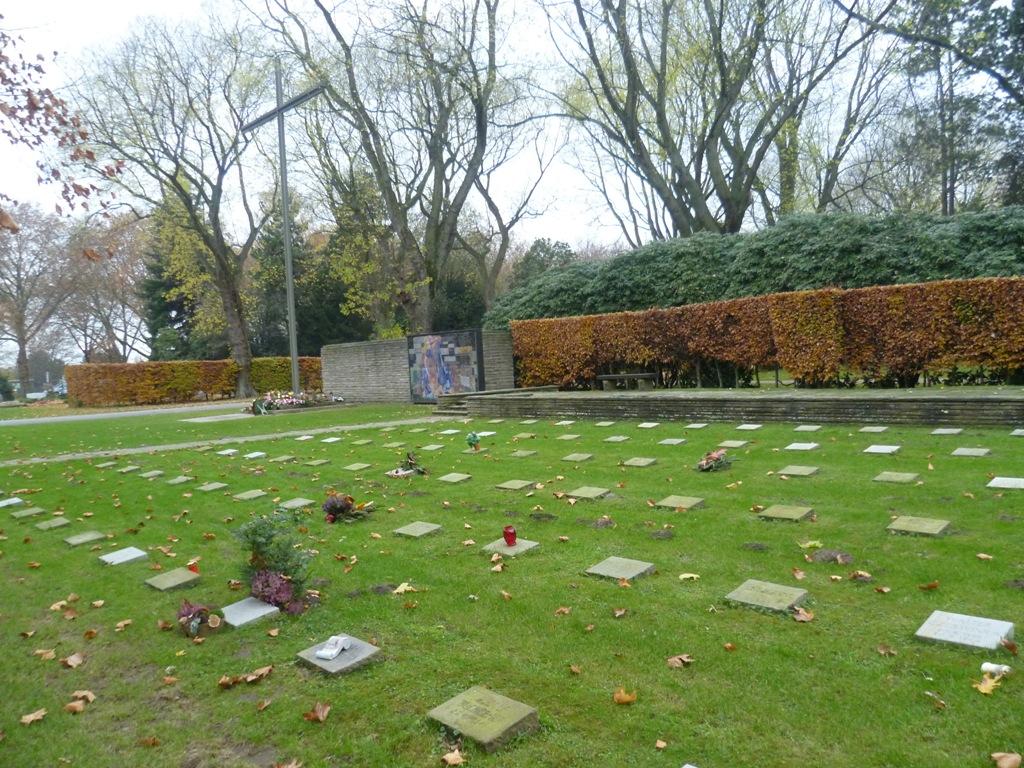
According to the information available to us, the total number of war dead resting on this war cemetery is: 3426 Of these from ... - Germany: 3426 - Former Soviet Union: 1452 - Poland: 78 - Yugoslavia: 11 - Belgium: 25 - France: 10 War cemeteries in Bochum A total of 6,283 war dead rest on 28 war cemeteries in the city. The largest war cemeteries are located at the main cemetery, the cemetery on Blumenstraße near the Bochum steelworks and at cemeteries in the districts of Günnigfeld, Höntrop, Langendreer, Wattenscheid, Weitmar and Werne. While the battles in the First World War took place outside Germany, Germany itself became a battlefield in the Second World War. With its enormous concentration of coal and steel industries, the Ruhr region was considered the "armory of the Third Reich". As a result, Bochum, Dortmund, Duisburg and Essen became the main targets of Allied attacks. The cities experienced an all-out bombing war. The first bombing raids on Bochum took place as early as spring 1943, with around 150 major attacks to follow. They mainly targeted the industrial companies Bochumer Verein für Bergbau und Gussstahlfabrikation, the iron and steelworks (now Stahlwerke Bochum) and the Bochum mines. The city was hit by heavy raids on May 13/14 and June 12/13, 1943. Bochum suffered its worst attack on November 4, 1944. 700 British bombers destroyed large parts of the city in just one hour with 140,000 bombs. 1.300 people died and 70,000 were left homeless. 100.000 citizens had already been evacuated or had left the city. They were sent to Pomerania, the Sudetengau or the nearby Sauerland region. As in all cities in the district, forced laborers, prisoners of war, mostly from Eastern Europe, and prisoners - mostly Jews - were primarily deployed in industrial companies in Bochum. At times, 1,700 people worked at the Bochumer Verein and 600 people at the Bochumer Hüttenwerk. They had to perform hard labor and were often treated inhumanely. Many Bochum citizens declared their solidarity with the terrible fate of these people and distributed food, for example, despite the threat of punishment. It was against this background that the partnership with the Ukrainian city of Donetsk was established after the war. According to the employment office at the time, there were 17,244 foreigners in the Bochum area (excluding Wattenscheid), including 4,525 prisoners of war and 7,178 men and women from the Soviet Union. In the summer of 1944, three satellite camps of the Buchenwald concentration camp were set up in Bochum: one camp with 50 prisoners as a work detachment of an SS construction brigade, one camp at the iron and steelworks and another at the Bochumer Verein. Numerous Jewish citizens of the city were deported to the Theresienstadt concentration camp in northern Bohemia between 1943 and 1945, others to the Auschwitz, Treblinka, Majdanek and Belzec concentration camps. Around 200 Jews from Bochum were murdered. In addition, 8,700 Bochum residents in uniform and 4,100 civilians were killed in air raids during the Second World War. On April 10, 1945, the city of Bochum, which lay in 5 million cubic meters of rubble, was handed over to the Americans. Bochum's main cemetery The cemetery grounds were newly laid out in 1929-1932. From 1933, the cemetery was a place of religious and political rallies. The listed buildings - including the large and small mourning halls - were built between 1935 and 1941 in the style of National Socialist architecture. The war memorial at the large mourning hall "The old and the young generation" was created by the artist Ludwig Kunstmann and was added in 1941. The figure "Life" at the small mourning hall was created by the same artist. In his dissertation on Bochum's main cemetery, Hans H. Hanke comments on the buildings: "Art has not been "misused" here - as is so often said - but has been used very consciously, purposefully and skillfully to aesthetically figure a repulsive ideology and thus make it attractive." The central memorial of the city of Bochum with a high cross and the mosaic "Niobe" by Ignatius Geitel was erected in 1954 opposite the large mourning hall. There is also a field of honor with urn graves for 8 murdered resistance fighters. In another cemetery there are further urn graves for 20 Bochum citizens who were murdered in the concentration camp. The Social Democratic member of the Reichstag Fritz Husemann, who was murdered in the Esterwegen concentration camp (Emsland) in April 1935, was also buried here. A memorial stone bears the inscription "A life for the miners". Another cemetery contains 684 Soviet prisoners of war and 30 forced laborers in a mass grave marked by a sarcophagus-like sandstone block. The inscription reads: "Their remains lie here far from home, but God's earth is everywhere." In another area there is a mass grave for 617 war dead: 442 from the Soviet Union, 16 from Poland, 9 from Yugoslavia, 10 from France and 25 from Belgium as well as 115 unknown persons. Another cemetery contains the remains of forced laborers who died in Bochum: 326 from the Soviet Union, 62 from Poland, 2 from Yugoslavia and 1 from Greece. A memorial plaque reads in Cyrillic: "Here rest the bodies of 39 Soviet citizens, deported into captivity 1941-1945". In a mass grave rest 1,676 Bochum citizens who lost their lives in the bombing raid on November 4, 1944. In another section, 295 Bochum citizens who died as soldiers are buried. Other war graves and memorials in Bochum The Jewish cemetery in Wiemelhausen was established in 1917. It is also the resting place of 52 people who died in the concentration camp at Bochumer Verein. in 1972, a memorial was erected in Wattenscheid for the murdered Jewish citizens. In Laer, a memorial stone commemorates 6 victims of the Kapp Putsch of 1920. The inscription reads: "They took our lives, but not our spirit". At the communal cemetery in Werne there is a memorial to the victims of the Kapp Putsch, to Bochum citizens who died in the Spanish Civil War 1936-1939 and to the victims of the anti-fascist resistance against the Nazi dictatorship from the districts of Langendreer and Werne. On November 4, 1956, 12 years after the terrible bombing of Bochum, the memorial "The Mourner" was unveiled at St. Paul's Church. A memorial plaque at today's boathouse at the former "Gibraltar" colliery commemorates the concentration camp set up there in 1933 for up to 250 deported Nazi opponents.