Germany
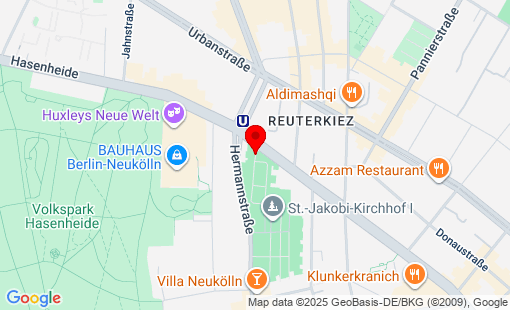
Berlin-Neukölln, Alter St.-Jacobi-Friedhof
Total Occupation: 201 fatalities
Total Occupation: 201 fatalities
Address
Karl-Marx-Str. 4
12043 Neukölln, Karl-Marx-Str. 4
Germany
The first cemetery of the St. Jacobi parish was built in 1852 on what is now Karl-Marx-Allee. The church itself was built in 1844/1845 in the style of an old Christian basilica according to plans by Friedrich August Stüler in Kreuzberg's Oranienstraße, after the parish was separated from the Luisenstadt parish in 1843 due to the growing population and the expansion of the parish districts. The church was destroyed on February 3, 1945 and rebuilt from 1953 to 1957. Due to the construction of the subway railroad at the beginning of the 20th century, a wide strip of land was separated from the cemetery and many graves were relocated. In this context, the chapel was also rebuilt in 1910-1913 in the style of an ancient Roman temple. in 1956, Hermannstrasse was widened, causing the cemetery to lose ground again; graves were relocated once more. Various personalities were buried in the cemetery: - Rudolf Fuess (1838-1917), mechanic who developed innovative precision instruments - Heinrich Kiepert (1818-1899), cartographer - Paul Otto (1846-1893), sculptor (including Wilhelm von Humboldt in front of the Humboldt University in Berlin) - Bernhard Koehler (1849-1927), industrialist and patron of the arts (supported, among others August Macke and Franz Marc) - Hermann Sander (1845-1939), manufacturer and local politician (1912 creator of the name "Neukölln" for the former Rixdorf, which is still used today) - Max Sielaff (1860-1929), engineer and entrepreneur (developed the first confectionery vending machines for Ludwig Stollwerck in 1888/1889) - Franz Skarbina (1849-1910), impressionist painter (grave of honor) At the Old StJacobi cemetery contains 40 graves of victims of the First World War and 223 graves of victims of the Second World War. (Martin Bayer, 17.04.2020)