Germany
Berlin-Lichtenberg, Zentralfriedhof Friedrichsfelde
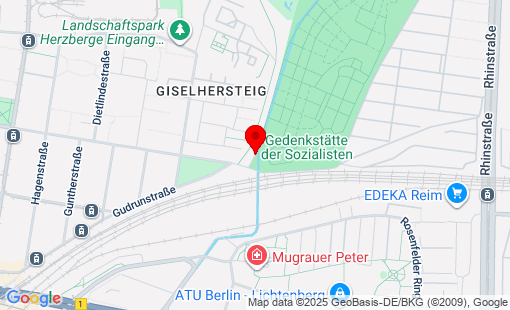
Total Occupation: 65 fatalities
Total Occupation: 65 fatalities
Address
Gudrunstr. 20
10365 Lichtenberg, Rummelsburgerstraße
Germany
The 32-hectare Friedrichsfelde Central Cemetery in Lichtenberg is one of the most famous cemeteries in Berlin. On April 28, 1880, the city of Berlin acquired 25 hectares of land outside its borders in what was then the municipality of Friedrichsfelde. The Berlin municipal garden director Hermann Mächtig designed the "Berlin Municipal Cemetery Friedrichsfelde" based on the model of the Ohlsdorf Cemetery in Hamburg. It was opened on May 21, 1881 as the "Friedrichsfelde Central Cemetery". For the first time, burials of the poor were carried out here, the costs of which were borne by the city administration; until 1911, all burials of the poor in Berlin took place exclusively in this cemetery, which became increasingly popular with wealthy citizens at the beginning of the 20th century due to its spacious park. The first urn burial took place as early as 1887. Although the cremation of the dead was prohibited in Prussia until 1911, the burial of ashes was not. in 1900, the cemetery became famous throughout Germany when SPD co-founder Wilhelm Liebknecht (1826-1900) was buried here: Around 150,000 people accompanied the funeral procession from Charlottenburg to Friedrichsfelde. As other well-known Social Democrats such as Ignaz Auer, Hugo Haase, Emma Ihrer and Paul Singer were buried there, the cemetery was nicknamed the "Socialist Cemetery". On January 25, 1919, 33 victims of the communist Spartacus uprising (January 5-12, 1919) were buried in a mass grave, including the body of the murdered Karl Liebknecht (a son of Wilhelm Liebknecht). Over the course of that year, further burials of dead revolutionaries took place, such as that of Rosa Luxemburg, who was also murdered. On June 13, 1926, the revolutionary monument by the later Bauhaus director Ludwig Mies van der Rohe was unveiled. Until 1933, so-called "LLL Weeks" were held here, annual communist marches in honor of Lenin, Liebknecht and Luxemburg. In February 1933, the memorial was severely damaged by the National Socialists and was completely removed at the beginning of 1935 when the surrounding graves were leveled. A memorial has stood on the site since 1983. Reconstruction of the monument has been discussed time and again. in 1947, the cemetery was extended by 7 hectares of land. On January 14, 1951, the "Memorial to the Socialists" in the entrance area of the cemetery, designed under the great influence of the President of the GDR Wilhelm Pieck, was inaugurated by him. The mausoleum of the Jewish Bleichröder banking family was also leveled for this purpose. Until the end of the GDR, this site served as a cemetery of honor for people who, in the opinion of the ruling SED, had rendered outstanding services to the "socialist idea". There are memorial plaques for Rosa Luxemburg, Karl Liebknecht, Franz Mehring, Ernst Thälmann, Rudolf Breitscheid, the writer Erich Weinert and others, including Otto Grotewohl, Wilhelm Pieck and Walter Ulbricht, who were particularly well known as GDR politicians. New graves have not been allocated since the fall of 1989, but commemorations for Rosa Luxemburg and Karl Liebknecht are held every year on the second Sunday in January. On December 11, 2006, a memorial stone for the victims of Stalinism, which has been repeatedly desecrated since then, was erected next to the socialist memorial. Various personalities were buried here, including - Emil Fuchs (1874-1971), ev. Theologian, member of the Reichsbanner Schwarz-Rot-Gold (Black-Red-Gold Banner of Democracy) and Nazi resistance fighter; he was instrumental in ensuring that conscientious objectors in the GDR were able to complete their service as "construction soldiers" (grave of honor) - Martin Kirschner (1842-1912), mayor of Berlin who was particularly committed to the common good (grave of honor) - Käthe Kollwitz (1867-1945), important graphic artist and sculptor who repeatedly dealt with war and poverty in her art (grave of honor) - Reinhold Lingner (1902-1968), landscape architect, among othersa. of the Plötzensee, Buchenwald and Sachsenhausen memorials (grave of honor) - Erich Mielke (1907-2000), 1957-1989 Minister of State Security of the GDR - Otto Nagel (1894-1967), painter persecuted by the National Socialists (grave of honor) - Richard Paulick (1903-1979), architect, including section C of the former Stalinallee (grave of honor) - Ludwig Renn (1889-1979), writer (e.g. "Steffie Spira (1908-1995), actress - János Veiczi (1924-1987), Hungarian-German film director and screenwriter - Konrad Wolf (1925-1982), film director ("Solo Sunny", "I was nineteen" etc.) Numerous victims of the First World War were buried at Friedrichsfelde Central Cemetery between 1916 and 1919, including many civilians who died of hunger and exhaustion. On January 29, 1978, a cemetery for the victims and persecuted of the Nazi regime was inaugurated; following a decision by the East Berlin magistrate in 1975, so-called VdN groves of honor were laid out in five cemeteries. There are around 900 urn graves here, each intended for two urns. This urn complex made the Friedrichsfelde Central Cemetery the largest burial site in Berlin for those persecuted by the Nazi regime and resistance fighters, including Kurt Bietzke, Werner Böhnke, Alfred Drögemüller, Fritz Eikemeier, Herbert Grünstein, Georg Henke, Erich Henschke, Kurt Langendorf, Georg Lehnig, Reinhold Lochmann and Ernst Melis. Since 2001, the Friedrichsfelde Central Cemetery no longer belongs to the Friedrichsfelde district, but to Lichtenberg; however, the name has not been changed. The Friedrichsfelde Central Cemetery has 2 collective burial areas of 594 m² and 405 individual graves with victims of the two world wars. (Martin Bayer, 16.04.2020)